Jannik Kochert held and presented the results of a workshop titled "What is the role of mathematics/computer science in society?"
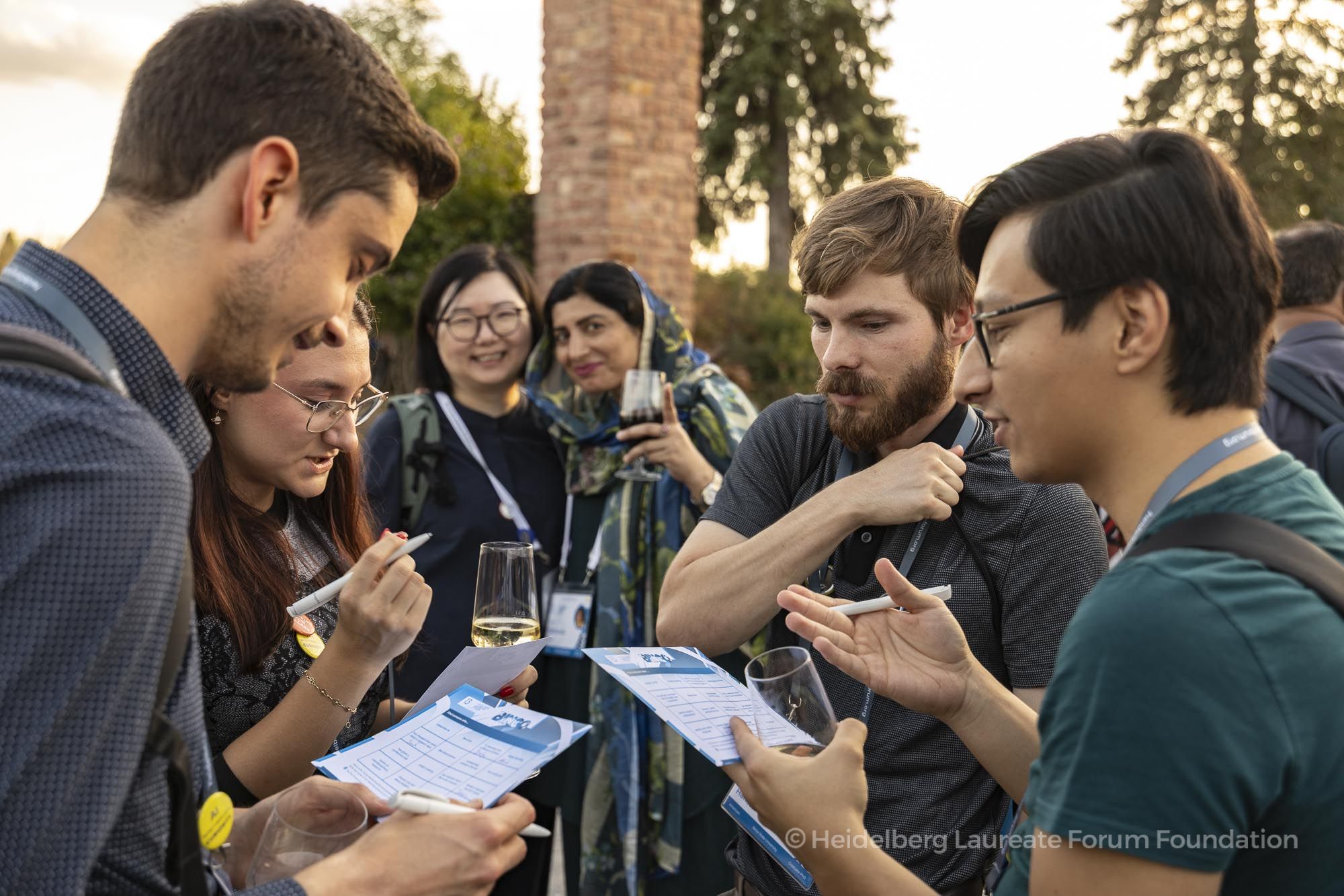
Jannik Kochert and Sebastian Krapp attended the 13th Heidelberg Laureate Forum 2026. Jannik Kochert was accepted as one out of 202 young researcher applicants and Sebastian Krapp was invited as a supporter for science communication.
The most important group at the forum are the name-giving Laureates, who are formed from winners of the most prestigious prizes in mathematics and computer science such as the Fields medal, the Turing Award, or the IBM Abacus award. These Laureates are then brought together with young researchers (Bachelor's/Master's students, PhDs, PostDocs), alumni (mostly professors), science journalists, supporters, and reviewers from all corners of the world and across all disciplines in and around mathematics and computer science to spend a collaborative week networking in the beautiful city of Heidelberg. Young researchers from 56 nations were present at the forum.
The program consisted of laureate lectures, series of short lectures, panel discussions, master classes, workshops, a poster session and flash talk session for young researchers, laureate small group interactions, a collection of concurrent young researcher workshops titled "un-conference", and lots of social evening events. Highlights included a lecture by Nobel Prize Laureate Brian Schmidt or a panel discussion with five top-level mathematicians on the use of AI in mathematical research.
For the "un-conference", together with postdoc Anne Josiane Kouam, Jannik was selected to lead a workshop on the role of mathematics and computer science in society and to present its findings in a crisp 90 second presentation. Together with a small group of young researchers, Jannik was also able to talk to John Hopcroft, one of the founding fathers of Chomskyan formal language theory.
Jannik and Sebastian both agree that this forum is one of the best opportunities for networking with many talented, passionate, and excellent researchers in all areas around mathematics and computer science. Especially Jannik has made lots of personal and scientific contacts with researchers at the forum. Both have successfully represented the research area of mathematical linguistics and have given and received ideas for future research directions. These ideas might end up resulting in further research collaborations – across disciplines and locations.