Talk on Realistic Virtual Sound Environments for Speech Research by Zino Wellauer
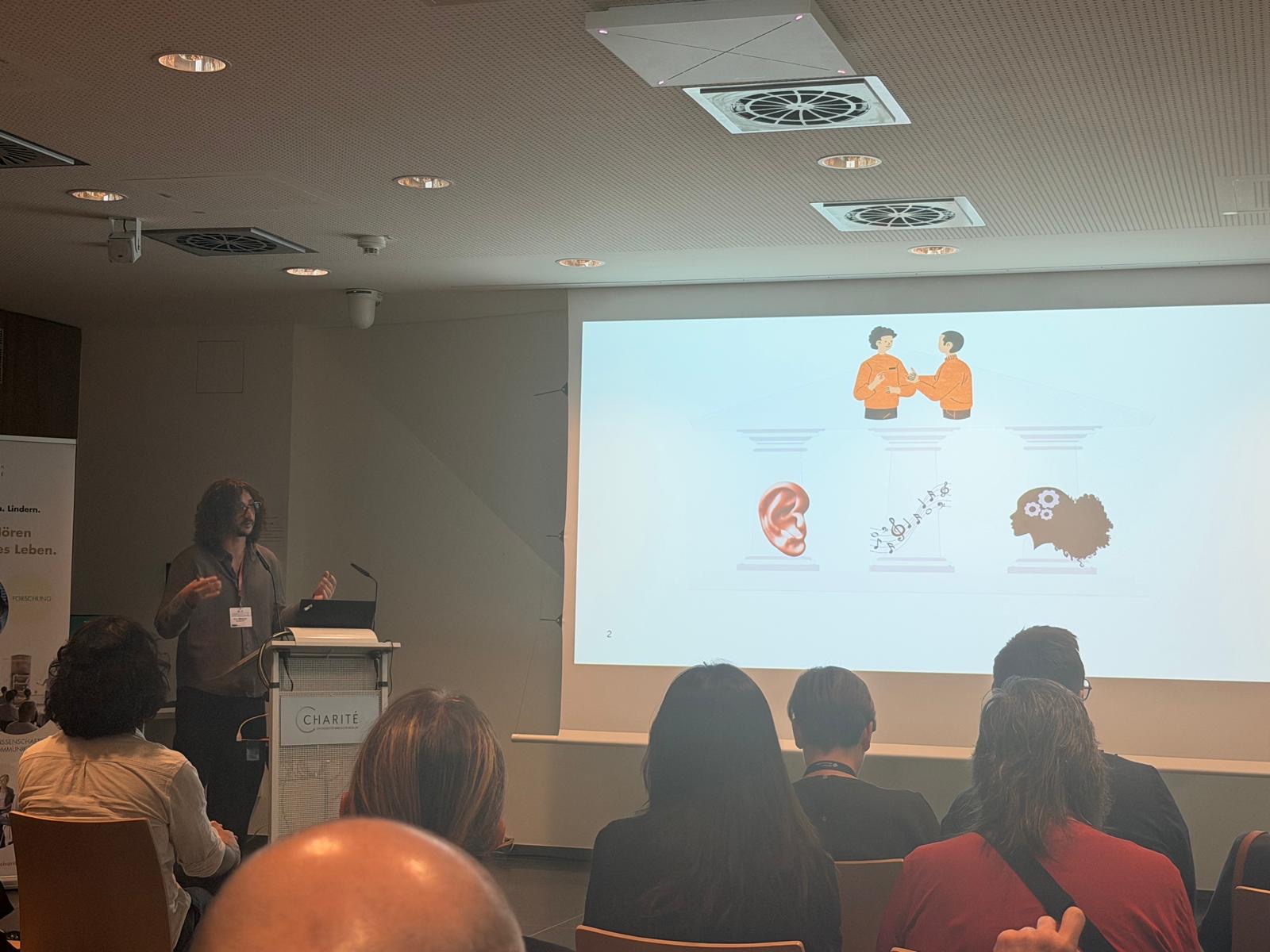
We experienced three days of non-stop tinnitus at the Charité in Berlin. With three posters and six talks, our group was well represented. Although it doesn't look that way in the photo, my talk was completely packed. People were standing along the sides and at the back; that's how full the auditorium was. Of the 200 or so people who attended, many came up to me afterwards. This not only allowed me to make new connections, but also motivated me to publish these results.
I presented the findings of our behavioural study, which is based on the so-called 'Speaker Dome'. This test environment comprises 37 individual speakers and simulates realistic, challenging listening situations. A pilot study involving 33 participants suggests that people with tinnitus have poorer speech comprehension in noisy environments than people without tinnitus, even if they have the same standard audiogram. Functional hearing tests revealed differences in the ability to detect changes in sound. Participants with tinnitus performed worse at their respective tinnitus frequencies and individual volume levels. However, when measured in the 500 Hz range, the opposite was generally true. The study concluded that “people with tinnitus hear more but understand less, and none of this is apparent in conventional hearing tests”.